



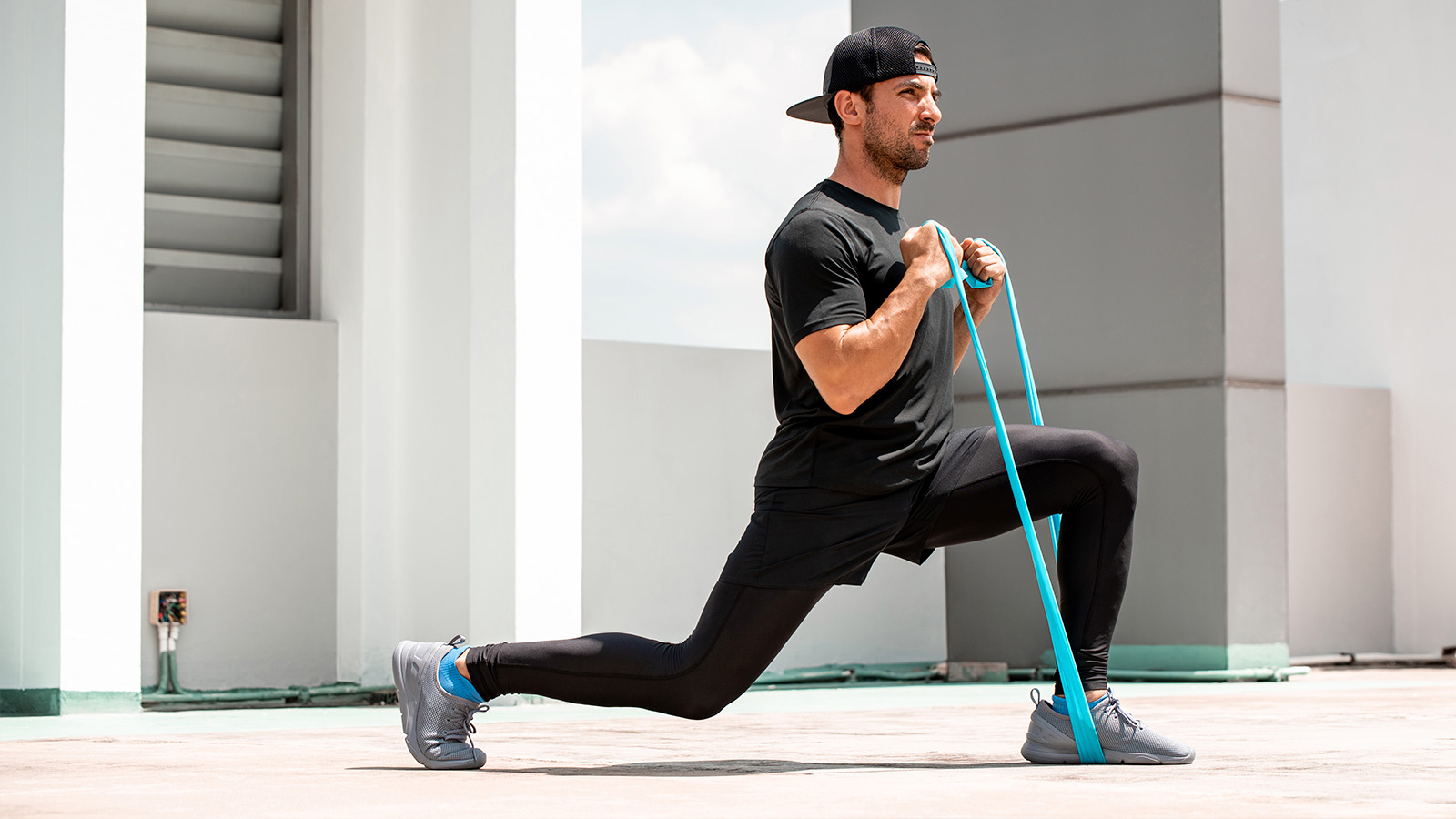
The bands provide the right amount of resistance that is essential for muscle building. And the good part? You can even continue your muscle-building workouts when you are on vacation or can work out from the comfort of your home without compromising your privacy.
Resistance bands are versatile and can find their way in every exercise while protecting your joints from developing injuries, and allowing you to progressively overload.
Types of Resistance Bands
Resistance bands for muscle building come in various types such as:
Flat Bands
Flat bands also known as therapy bands are thing, and long. The bands have a particular use in physiotherapy and rehabilitation. It is also used by people for light stretching after workout or sometimes in yoga or Pilates. They come in different levels of resistance such as 10 lbs. to 20 lbs. They are a good option for light resistance to regain muscle strength.
Loop Bands
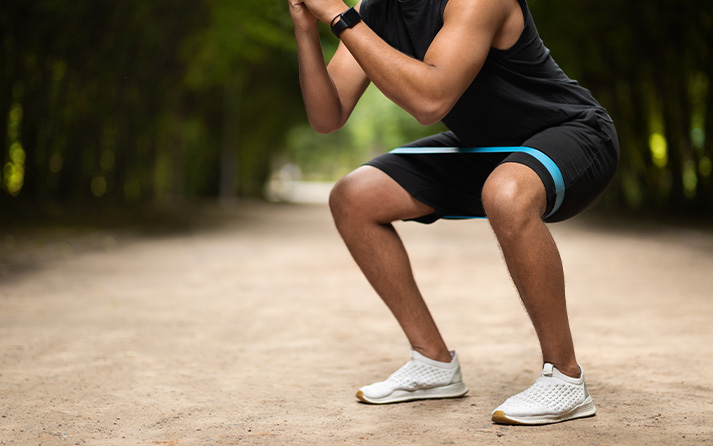
These bands can be used in various bodyweight exercises such as box jumps, bear crawls, hip bridges. They have a flat loop which can be used easily for a variety of purposes such as resistance in workouts or physiotherapy. The loop bands are usually color-coded and come in different resistance levels like 5 lbs. to 25 lbs.
Tube Bands with Handles
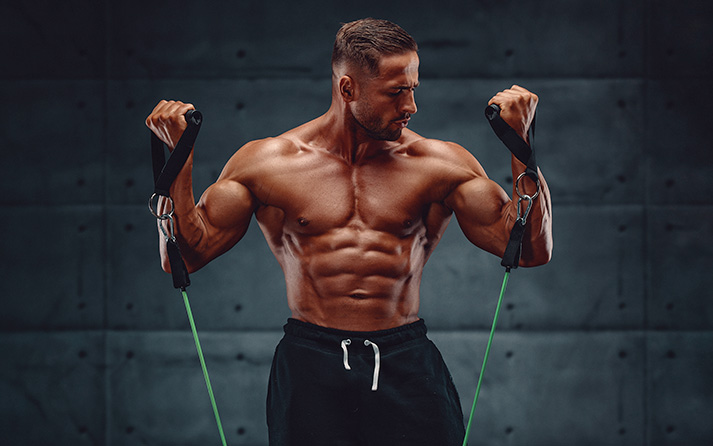
Tube bands with handles can be attached to a bar, pole, or door anchor to mimic the effect of gym cable machines. These bands come in resistance levels of 10 lbs. to 30 lbs. and can be used together for a greater resistance. The tube resistance bands are perfect to use in exercises like rows, chest presses, etc.
Pull-Up Assist Bands
The pull-up resistance bands have a perfect use in advanced strength training exercises such as pull-ups or dips. These bands also come in different resistance and thickness levels, and provide a great burn to muscles. The pull-up bands allow beginners to do advanced exercises with a proper form and technique.
Fabric Bands
The fabric bands or hip bands can be used easily in many lower body exercises for strength and stability. You can place them just above your knees or ankles for a deeper glute activation. The fabric bands come in three resistance levels, with light having a strength level of 18 to 32 lbs. and heavy level with strength of 45–70 lbs.
Related article: How to Add Variety to Your Workouts with Resistance Bands
Benefits of Using Resistance Band for Muscle Building

The best resistance bands for building muscle can be used in many exercises. Using resistance bands is not merely equivalent to using an equipment in exercises, rather they have many benefits, such as:
Portability and Affordability
The bands come in a very compact design, which means you can easily carry them anywhere you want. If you are travelling for some days, and don’t want to take a break in your routine, then resistance bands workouts can be a great help. Other than that, bands are also an affordable option as compared to traditional strength training equipment.
Deeper Muscle Activation
The exercises with resistance bands give a great burn to muscles and activate muscles. The varying resistance levels means you can experiment with different levels in exercises. For instance, if you are doing a heavy squat with a barbell, then wearing the band just above your knee will add great tension to glutes, activating the deepest muscles, and helping in building the strength.
Reduced Injury Risk
The resistance bands exercises are generally safe to do with a reduced injury risk. Wearing a band allows you to open the muscles to some extent only, meaning you have a very controlled movement, activating all muscles. The slow movements with resistance bands strengthen your joints and muscles, reducing the risk of developing injuries.
Targets All Muscle Groups
Resistance band training is effective and works because it targets all muscle groups in the body. For example, bands can be used in upper body exercises, lower body workouts, core exercises, and rehabilitation as well. They are a perfect substitute for heavy weight training equipment.
Resistance Band Exercises for Muscle Building
Resistance bands add great tension to muscles. You can easily build muscle at home with a resistance band strength training routine only. The most important thing is to find a resistance level that works for you in different exercises. Loop bands or fabric bands are a suitable option for workouts. Following are some of the exercises that can be done with resistance bands:
Upper Body Workouts
Upper body workouts build strength in the chest, shoulders, upper back, arms, and forearms. It is necessary to incorporate upper body workout days in your routine to build strength in these muscles. Following is the resistance band upper body training routine:
- Arms: Get a 5 lb., band if beginner, and start the arm workout with exercises like triceps extensions and bicep curls.
- Shoulders: For shoulder strength and mobility, do exercises such as overhead presses and lateral raises.
- Chest: A resistance band chest press and chest fly will activate the deepest muscles, leaving you sore for the next day.
- Back: Seated rows, pull-aparts, and lat pulldowns can be done to target back muscles.
Lower Body Workouts
Lower body exercises can be done effectively with resistance bands. You can use bands in combination with other weighted equipment or use them alone to target lower body muscles.
- Legs: Wear the band just above the knee for exercises such as squats, lunges, and leg presses.
- Glutes: Get a resistance band of strength level above 10 lbs. for targeting glutes. Donkey kicks, lateral band walks, and glute bridges are some exercises that can be done with bands.
Core Workouts
Resistance bands can be used in core workouts. Start with a lower strength level to do the core exercises such as oblique twists, plank band reaches, and seated band crunches. Once you are comfortable with this strength level, progress to the next level.
How to Use Resistance Bands for Specific Muscle Groups
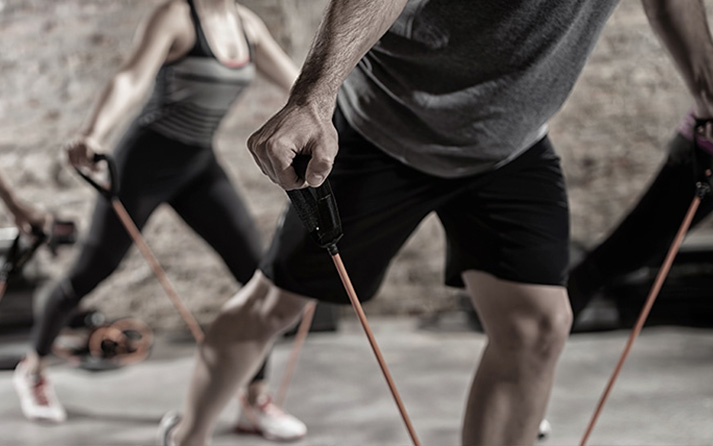
No doubt, almost every exercise can be done with resistance bands. But you might be wondering how to use them in a routine. Following is a detailed guide for you to understand how you can utilize bands in your routine:
How To Use Resistance Band For Arms?
To use resistance bands for arms, grab a strength level that is comfortable yet challenging enough. For example, for bicep curls, you can start with 5 lbs., and for triceps kickbacks, you can go up to 15 lbs. Hold the bands tightly with both hands and gradually move your arms for biceps curls. Pay attention to your form and technique to get the muscles pumped.
How To Use Resistance Band For Legs?
Squats and lateral band walks can be done easily with a higher resistance level. But again, assess your strength and check if a specific band is not comfortable. To do the squat, wear the band above your knees. You can also use tube resistance bands for lower body exercise and anchor the handles to the squat rack for a massive burn.


How To Use Resistance Band For Pull-Ups?
Pull-up assistance bands can improve form and technique in advanced strength training exercises such as dips, chin-ups or pull-ups. The bands can provide support by reducing the weight that has to be lifted. The bands also increase muscle engagement, and are a great option to progress gradually.
How To Use Resistance Band At Home?
Resistance bands can also be used easily at home for a full-body workout. One can plan their routines by incorporating bodyweight exercises and workouts with resistance bands for a complete burn at home.
Related article: This Full-Body Strength Workout Will Hit Every Muscle in Your Body
Creating a Resistance Band Workout Plan
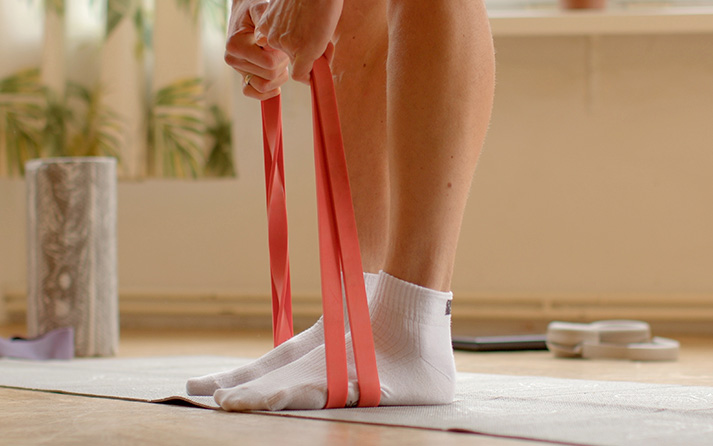
Creating a banded workout plan is easy. Just like any other workout, you have to make sure that you are ticking all essential boxes for a wholesome workout routine. Following are some ways to create a solid workout routine with resistance bands to build muscle:
Structure Your Workouts
Your workouts should be structured with a proper warm-up, cool down, the sets you will be performing, the reps you will be doing, and the rest periods. Take out time to plan your routine and include movements in all planes of motion. This will help you to follow a consistent routine, targeting all muscle groups in the body.
Assess Your Fitness Level
Before starting any workout routine, assess your fitness level. For example, beginners should start with light bands with exercises such as seated rows, bicep curls, triceps extensions, or squats. Advanced users can move to a high level of strength and do exercises such as chin-ups and pull-ups. Find what workouts work for you, and plan your routine around it.
Progressively Overload
Progressive overload is the key to building muscle and strength. With resistance band workouts, you have to make sure that you overload after every few weeks or months for muscle building. You can change your bands and experiment with high strength levels or increase your reps to overload the muscle.
Related article: What is Progressive Overload? | Progressive Overload Training
Tips for Maximizing Results with Resistance Bands
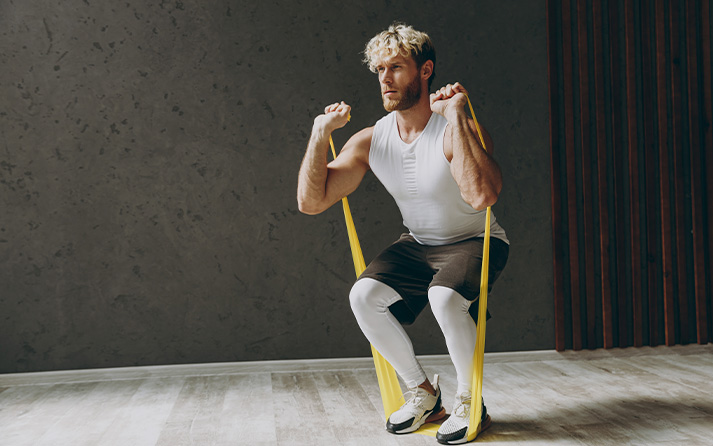
Resistance band workouts can be an effective way to build muscle mass and strength. To maximize their effectiveness in your workout routine, make sure to follow these basic tips:
Choosing the Right Resistance Level
Finding the right resistance level is an essential step. If you start with a heavier band while you don’t have the strength to bear that resistance, you might put yourself at risk of developing serious injuries. As mentioned above, resistance bands come in varying strength levels, such as light and heavy. In case you are just starting your fitness routine, a light band will be sufficient for all exercises.
Proper Form and Technique
Like any other exercise routine, maintaining a proper form and technique is important in resistance band workouts. Not paying attention to your technique will do more damage than good. It can affect your muscle strength and can also be a reason for developing chronic body pains. It is best to start slow and incorporate mindful movements in routine with a complete focus on form to avoid the risk of injuries. If you experience some pain or discomfort, immediately stop the workout.
Using Other Equipment
Resistance band training can be extremely beneficial for you if you combine other equipment or other forms of exercises too. For example, a cardio day in your workout routine will boost your fitness levels. Using other equipment such as barbells in your leg days combined with resistance bands will add great strength and challenge to the routine.
Common Mistakes to Avoid
Some common mistakes that people usually make when using resistance bands are:
Using Incorrect Resistance Levels
If you are not fit enough to use a higher resistance level, then it is best if you skip them completely. Not doing this can put you at a greater risk of developing injuries in muscles and joints. Or if you are an advanced user and can take heavy bands but use a light band, then doing any exercise will bring no benefit.
Not Prioritizing Rest
Using too many resistance bands in exercises or not taking a break in your workout routine can halt the muscle-building process. In every workout routine, it is important to prioritize rest and give a break to the muscles. Work out with bands for 4–5 days and then make sure you have active recovery days.
Incorrect Exercise Form
An incorrect posture during exercises can lead to injuries during workouts. When doing a resistance band exercise, make sure you have proper core engagement. This will help you fix your workout form and technique. Other than that, you need to know how to place the bands correctly when targeting different muscle groups, such as the upper body, lower body, or core.
Not Attaching Bands Securely
When using tube resistance bands, it is important to ensure you have anchored them correctly to a sturdy surface. Check the anchor before starting the workout. If bands are not anchored properly, you will put yourself at a greater risk of developing injuries and serious accidents at the gym.
Related article: 3 Worst Weight-Lifting Mistakes You Should Avoid
Conclusion
Resistance bands are a versatile, and portable workout equipment. With them by your side, you can work out anywhere you want. They are a perfect alternative to dumbbells and barbells when you are travelling. The varying resistance in these bands help in building lean muscle mass, helping you to achieve fitness goals with ease.
Resistance bands come in a wide range of types and resistance levels that you can easily use in many ways. The major benefit of band is its adaptability with all fitness levels. No matter if you are a beginner or an advanced user, you can incorporate bands in your workouts to feel deep muscle activation and tension.
From upper body exercises to lower body, and core days, the bands can be used effectively in every workout. Get resistance bands for your next workout session, and see the difference they make in your normal routine. You can use them in combination with your other workout gear or alone to activate the muscles.
Read More
- Arm Blasters for Bicep Workouts: Benefits, Techniques, Improve Form, and Boost Growth
- Maximising Fitness: Unveiling the Advantages and Cautions of CrossFit Workouts
- Streamlining Workout Efficiency: A Comprehensive Guide to Circuit Training
- Isolation vs. Compound Workouts: Analyzing the Advantages and Disadvantages