



It’s not flashy, nor a knockout move. It’s quiet. Ruthless. Efficient. A control technique that basically says, “You’re not going anywhere.”
So what exactly is this mysteriously disarming move – Dagestani Handcuff? Let’s dissect it below:
What Is the Dagestani Handcuff?
We will start by simply explaining what the world sees.
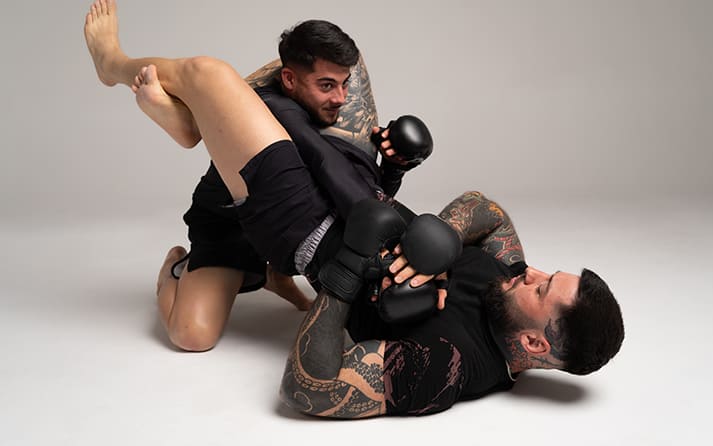
The Dagestani Handcuff is a wrestling technique in which one arm is totally locked behind the back, and the opponent has pinned you down and sits very comfortably on top of you.
It’s common in Dagestani wrestling and combat sambo, where control matters more than chaos. Fighters from that region grow up learning to dominate from the top. They don’t just pin you down, they suffocate you, they leave you without a way out!
It requires a lot of practice and technique. Not everyone can pull it off. Basically, the top fighter slides an arm under yours, grabs your wrist with force, and yanks it behind your back. Their chest or leg pressure keeps you flat, unable to turn.
Khabib Nurmagomedov and the Dagestani Handcuff in the UFC

Khabib Nurmagomedov made this move famous.
Watch any of his fights. Michael Johnson. Conor McGregor. Dustin Poirier. It is the same story every time. The fight hits the ground, and suddenly, the opponent’s arm disappears behind their back.
That’s the Dagestani Handcuff.
He didn’t just hold them there. He punished them. Short punches. Shoulder pressure. Whispered reminders that they weren’t escaping.
The best part is that he does it so effortlessly, so calmly. If you saw it, you’d think it’s the easiest thing to do on earth. It is more like he was checking his phone mid-fight. That’s how it feels.
Khabib’s ground control is related to his fight psychology too. It is not just his physical strength that does this trick. His move casts fear in hearts. You’d see opponents trying to explode out. Getting nowhere. Realizing, too late, that the more they struggled, the tighter it got.
This is the climax of the famous Dagestani Handcuff.
How the Dagestani Handcuff Works?
Okay – let’s slow it down and look at how it actually works.
- Step one: Khabib (or any fighter using it) gets top control.This happens usually after a takedown.
- Step two: He isolates an arm. One arm.
- Step three: That arm gets pulled behind the opponent’s back, locked down with pressure.
Now the bottom fighter’s stuck. They can’t post up. Can’t strike. Can’t move without exposing themselves to something worse.
And that’s when the real control starts.
From there, the fighter on top can strike freely, shift positions, or start hunting submissions. The trapped fighter has no chance because they are just defending and that too with one hand only.
The most amazing part is that the Dagestani Handcuff MMA is awfully simple but ruthless like no other. It leaves the opponent no chance of victory at all.
Common Submission Setups from the Dagestani Handcuff (bullet guide)
Rear-Naked Choke
- What happens: Opponent panics, turns away to try and escape the trapped arm.
- Setup steps: maintain the Dagestani Handcuff to crush posture. Follow the turn and take the back as they expose their spine. Secure hooks and sink the rear-naked choke.
- Why it works: the trapped arm takes away frames and posting. Their back opens like a target.
Armbar (Top-to-Armbar transition)
- What happens: Top isolates the arm enough to break the bottom’s base.
- Setup steps: keep the wrist locked behind their back. Shift hips and slide a knee across their head/shoulder. Swing the opposite leg over and extend into an armbar.
- Why it works: The handcuff removes the arm’s defensive path, so the armlock becomes a short technical chain.
Kimura (Shoulder crank)
- What happens: The trapped arm can be grabbed and folded toward the back.
- Setup steps: Trap the wrist, switch your grip to grab their wrist/forearm with two hands. Roll the elbow away and secure the figure-four grip. Crank the shoulder for a Kimura.
- Why it works: The handcuff sets the limb in an awkward line, making shoulder isolation easier.
Arm-Triangle / North-South Choke
- What happens: Opponent tries to relieve pressure by turning, and meanwhile the person on top uses the head and arm to compress the neck.
- Setup steps: Trap the arm and use chest/shoulder pressure to flatten them. Walk around to side control or north-south while pinning the trapped arm. Slide your head and forearm to complete an arm-triangle.
- Why it works: The trapped arm helps create the choking frame and removes their ability to posture.
Transition to Mount / Ezekiel-Style Finishes
- What happens: Top climbs into mount while the arm stays immobilized.
- Setup steps: Keep pressure, step over into full mount. Pin the arm across their chest or head. Either rain down strikes or hunt for an Ezekiel or an Americana-style finish if the sleeve/grip opens up.
- Why it works: Immobilising one limb makes mounting safer and gives time to find oddball subs.
Anaconda / D’Arce or Choke Chains (when they scramble)
- What happens: In scramble moments, the trapped arm and their turn create openings for head-arm chokes.
- Setup steps: Bait a turn, thread your arm under their neck and around the trapped limb. Lock the grip and roll into an Anaconda or D’Arce choke.
- Why it works: The handcuff funnels their movement into predictable paths you can capitalise on.
Ground-and-Pound. Submission Conversion
- What happens: Heavy strikes force defensive reactions and sloppy escapes.
- Setup steps: Use the Dagestani Handcuff to control and pepper strike the head/shoulder. As they flap and try to protect themselves, switch grips and slide into a choke or arm attack.
- Why it works: Strikes create openings. Panic creates mistakes. You convert the chaos into a submission.
Related Article: Boxing vs. MMA: Which Combat Sport Poses a Greater Injury Risk?
How to Escape the Dagestani Handcuff?
Well, technically, you can.
If you move early enough, you might shrimp, bridge, or posture your way out. Maybe even roll before the arm gets fully trapped. However, once locked, there is not much a fighter could do. Your options shrink pretty and your opponent’s hold becomes lethal.
Most fighters try to explode out, but that’s absolutely useless, at least, against Khabib. He’d ride the motion, stay glued to them, and turn it into deeper control.
That’s the psychological part. The more you fight, the worse it gets. And soon, you’re just surviving. That’s why elite grapplers love the Dagestani Handcuff wrestling technique. It drains energy, crushes spirit, and ends resistance.
Why It’s Effective in MMA?
It’s a power move and very, very effective in MMA. Here’s why:
Total Top Control
The Dagestani Handcuff MMA system locks opponents down without risk.
You can strike, pass guard, or just stay heavy until they break.Safety with Pressure
You’re attacking while staying safe.
No space for reversals, no wild scrambles. Just steady domination.Mental Collapse
Being trapped isn’t just physical – it’s psychological.
Breathing gets harder. Thoughts get slower. Panic kicks in.Universal Effectiveness
Works on everyone.
Strikers, wrestlers, black belts – it doesn’t care who’s underneath.The Philosophy of Control
It’s not a move. It’s a mindset.
Control first. Damage later. Win always.
FAQ’s
The Dagestani Handcuff is a move that’s backed by strong psychology. Control over chaos. Pressure over panic. It’s what made Khabib Nurmagomedov unstoppable in the UFC. It is the perfect mix of technique and dominance. He showed the world what Dagestani wrestling really means: total command on the ground, no wasted motion, no escape.
Understand this move, and you understand Khabib. Understand Khabib, and you understand what true control in MMA looks like.