




How did this world of bare knuckle boxing change? We’re gonna find out by looking through all the major periods that changed the world of boxing to what it is today!
Ancient Pugilism: The Origins of Boxing
Remember what I said about boxing and Britain? Yeah, that happens later, but the story of punching people for sports has been around for a long time. The history of boxing has its roots in all sorts of civilizations, each having its own version of the sport. But we haven’t yet traced the origins of boxing to one specific culture.
The first visuals we have of boxing come from a relief sculpture from ancient Egypt, specifically from Thebes, where we see that, even in those days, combat wasn’t always about survival. It was about the sport, the challenge. Since we closed our hands to make a fist, we tried to use it to fight, and since the rise of civilization, we’ve tried to find something deeper within it.
Still, the early boxing rules were practically non-existent. There were no gloves to keep the fighters safe, and most of these ended in death. It was primal, and the events were often held for ritual or entertainment purposes, a bit of bloodletting to get the party started, as it were. That’s how ancient pugilism came to be.
The Bare-Knuckle Era
After that, the era of wearing weapons became more common, so fisticuffs weren’t in style anymore. We see a few instances between the 12th and 17th centuries of it popping up, but it never lasted long, and it looked like the era of boxing was at an end.
But the need to feel your fist on skin doesn’t just go away. That’s why bare knuckle boxing started to rise in the Isle of Britain around the 17th century. People couldn’t carry around swords, so they started carrying a different kind of weapon. One not easily taken.
That’s how the prizefighting era came to be. It had the bones of what we see now in modern boxing. They were pretty light rules then, bare knuckle boxing. There wasn’t a time limit in those fights. They ended when your opponent couldn;t get back up.
It was still unpolished. Too rough. Too…cruel. But the history of boxing wouldn’t be the same without the stepping stones this era paved. It laid the foundation of the sport, especially when Jack Broughton, a champion bare-knuckle boxer, brought the first set of actual rules called the Broughton Rules to keep boxers alive. It was also where he encouraged the use of bandages or wraps for their hands, and it was the first step to the move to the gloves we have now


Related: Lead Hook Defense: How to Block, Slip, or Roll Safely in Boxing
Marquess of Queensberry Rules: Modernizing the Sport
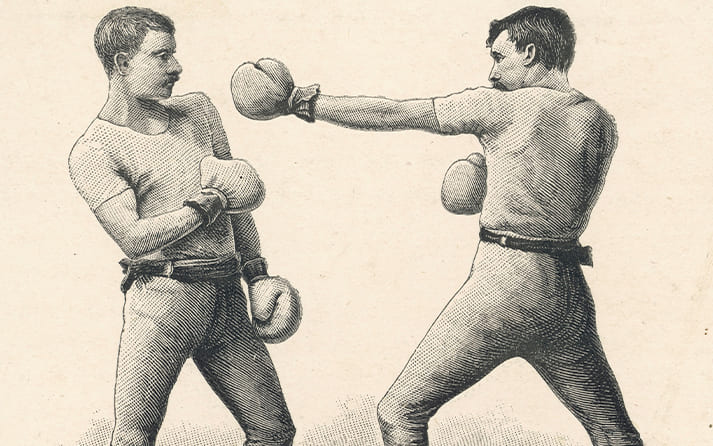
By the late 1800s, you could see a change in the world of boxing. The early boxing rules were thrown aside, and there was a shift in attitude. It was becoming popular, so it had to get more organized, more…gentlemanly. That’s when the Marquess of Queensberry rules came to be in 1867 by John Chambers.
There was actual structure to the game. No longer were folks going to shudder through a huge, jacked giant of a man, face down a short king in a brutal slaughter. There were weight classes, time limits, and actual stage so spectators could see these titans duke it out.
Including the ones before, there were 12 rules in all to make sure boxing could be as fair as it can be. They stopped moves like gouging and kicking. Instead, the fighters focused on defensive maneuvers; bobbing and weaving every strike, the initial steps to the primal dance we see in modern day boxing.
Those simple rules transformed the history of boxing from a bare knuckle brawl to a game of skill and showmanship. But it was about to take a turn.
Related: Boxing for Mental Clarity: How Fighting Improves Focus and Confidence
The 19th and 20th Century: Boxing Banned
By the late 19th century, boxing and bare knuckle brawling were seen as uncivilized. The fights were often held at gambling dens and despite the rules, there was still plenty of danger and death every time you stepped up in the ring. Eventually, it was straight-up outlawed. It was the end of the history of boxing.
Well, not really, though. Just because something’s illegal doesn’t mean people will stop. There were even a few notable boxers in those days, like “Gentleman Jim” Corbett. It was getting tough, though, as the first attempts at censorship by the U.S were in 1897 when they started banning prize fighting videos from being distributed.
Things were looking bad, but as you’d probably guessed, it got better. While the world of boxing was still looked down on for a while, fans of the sport, like Tex Rickard, put a lot of work into getting it recognized and promoted. It also helped that the rise of champions like John L. Sullivan helped legitimize the sport and give it the room to grow into what we’re gonna get into now: modern sports.
Boxing in the Modern Era
From the ashes of gambling dens and prize fights came the multi-billion-dollar empire. It’s quite something, seeing the evolution of boxing after knowing what its history was. What was once trapped in the confines of Britain and America has become a global field that’s recognized as an official sport, worthy of being part of the Olympics.
It was bright, shining, and gave rise to iconic fighters that changed not just the history of boxing but also pop culture as we know it. So many movies and references were created from boxing legends. With that kind of popularity came greater support. Regimens, diet plans, and workout routines to master the art of fighting, to transform oneself into the ultimate warrior, and to move to the next level of fighting.
FAQ’s
The world of boxing was very different from what we know now. The move from its rough and brutal origin wasn’t easy. There were stop gaps, disputes, and even the law to stand in its way. But they kept going. People kept finding a way to continue until it became the martial art we see now.
All of this came forward from centuries of practice and improvement. These few fighters, these ancient warriors, moved so that their successors could improve, so our generation can evolve this into a sport celebrated and recognized worldwide.