



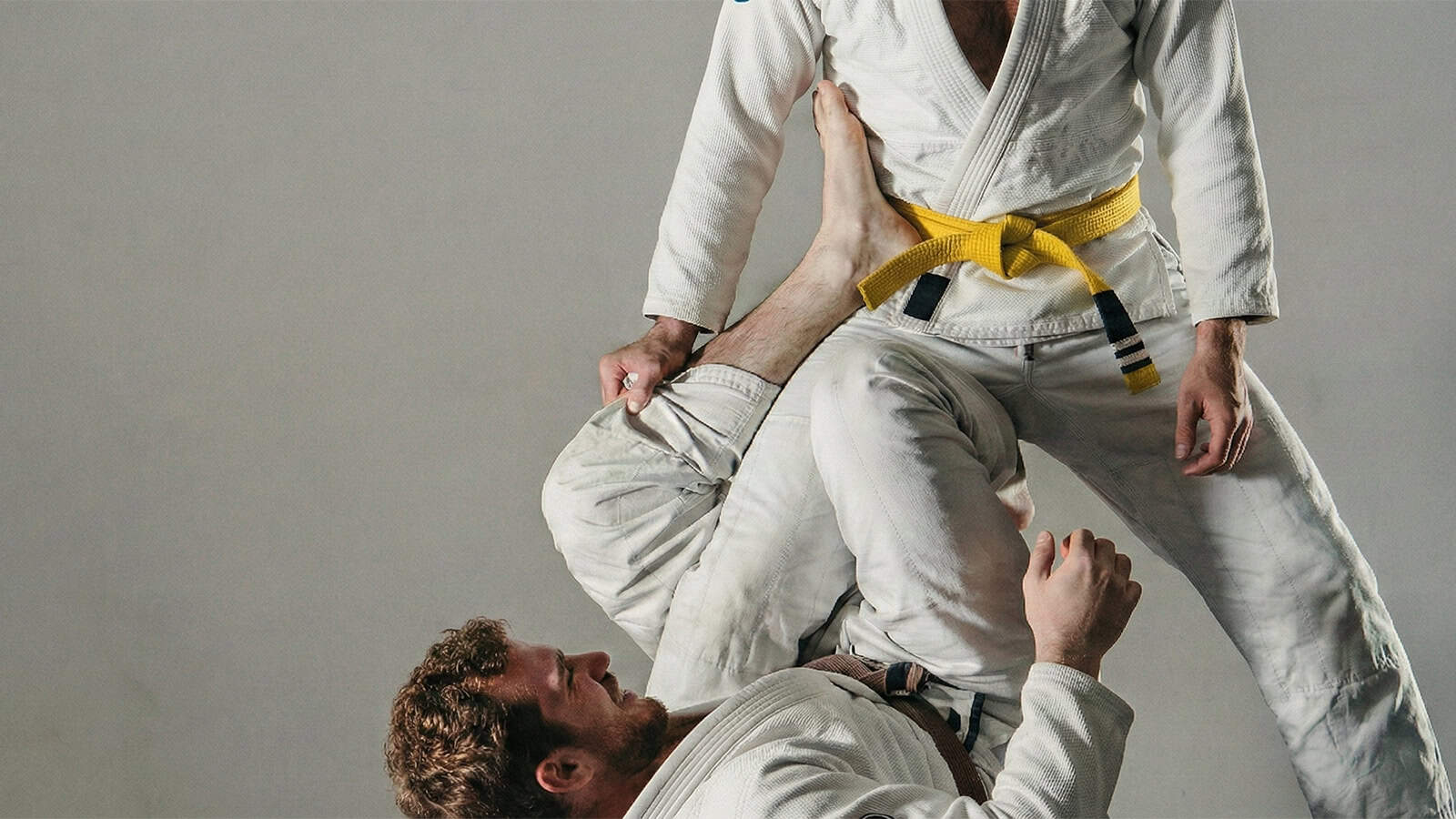
The X-Guard position gives fighters the ability to control and sweep opponents from the bottom with precision and leverage. It’s one of the most important open guard variations ever developed.
What is the X-Guard?
So, what exactly is the X-Guard?
It’s a grappling position where the fighter on the bottom uses their legs to form an “X” shape around the opponent’s leg. That leg structure creates control, leverage, and balance disruption – three words every grappler loves.
Here’s the basic setup: one leg hooks behind your opponent’s thigh, while the other crosses in front, forming that signature “X.” Your hands are busy gripping the opponent’s ankle, knee, or sometimes the hip, depending on the rule set.
The beauty of the X-Guard lies in how it offers safety and control at once.
It’s one of those guard positions that feels like magic once you get it right. No wonder the Marcelo Garcia X-Guard became legendary.
Origins and Evolution: Marcelo Garcia’s X-Guard Legacy
Every great technique has a story, and this one starts with Marcelo Garcia.
Back in the early 2000s, Garcia used his X-Guard to flip the script on bigger, stronger opponents. His innovation wasn’t just about winning matches – it changed how people thought about open guard variations altogether.
He showed that with proper leverage and timing, even a smaller grappler could dominate. Garcia’s system inspired a generation of athletes to build on it, adapting it to no-gi and, eventually, to MMA.
In modern mixed martial arts, the X-Guard evolved again – it became a setup for leg entanglements, single-leg entries, and smooth reversals. Fighters learned that it’s not just a “BJJ move.” It’s a control mechanism that transitions beautifully into striking-based scenarios.
That’s the thing about techniques born in BJJ – they keep growing. The Marcelo Garcia X-Guard isn’t frozen in time. It’s still evolving.
Anatomy of the X-Guard: How it Works?
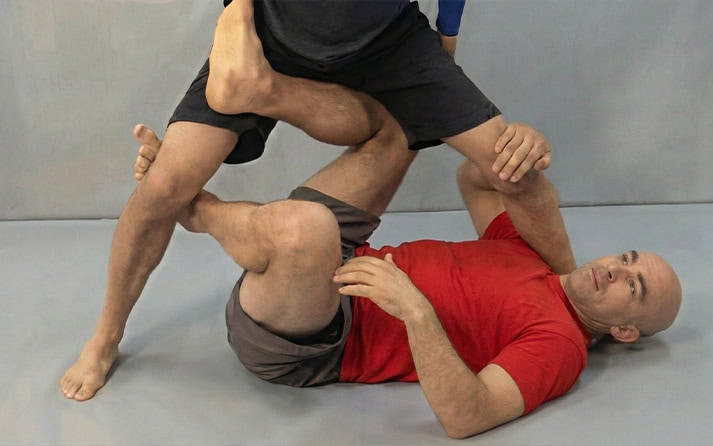
Mechanically, the X-Guard is all about geometry and leverage.
Your lower body forms the “X,” one leg under, one across. Your core stays tight, your hips lift, and your hands maintain posture control, gripping at the ankle or knee to dictate movement.
The goal? Simple: off-balance your opponent. Once they shift their weight, you sweep and transition into top control.
Some fighters even flow directly from X-Guard sweeps into back takes or leg locks. It’s fluid and dynamic, like water finding its way downhill.
The real secret is leverage. You’re not fighting strength with strength. You’re using positioning to manipulate balance. That’s why the X-Guard MMA setup works so well against bigger fighters, it neutralizes power.
And perhaps most importantly, it’s safe. You’re underneath your opponent’s base, not exposed to heavy ground-and-pound. In other words, you’re in control even from the bottom.
Related Article: Armbar Techniques: Top 5 Submissions for MMA Fighters
Common X-Guard Variations
The X-Guard is a family of related setups that fit different moments in a fight.
Single-Leg X-Guard
This one’s all about isolating one leg. You’ll often see this in no-gi grappling and MMA scrambles, where fighters need quick reversals.
Butterfly Guard to X-Guard
This transition is smooth and sneaky. From butterfly, you scoot under your opponent and hook their leg into the X-Guard position. Perfect for elevation sweeps. It’s one of the most fluid open guard variations in the game.
Deep X-Guard
The “deep” version lets you slide even farther under your opponent, giving you maximum lift. It’s used for powerful, controlled sweeps – the kind that leave your opponent staring at the ceiling.
Standing X-Guard
Less common but surprisingly effective. It helps off-balance opponents who try to posture up or disengage. A rare but valuable tool for maintaining control when your opponent wants to bail.
From the butterfly guard to X-Guard, from single-leg X-Guard to deep transitions – these variations keep the position endlessly adaptable.
How MMA Fighters Use the X-Guard?
In MMA, the X-Guard plays a more strategic role. It’s not just about pretty sweeps – it’s about control and reversals that matter in a fight.
It’s a safer alternative to more open guard positions since you’re less exposed to heavy punches.
Common transitions include the X-Guard sweep to top mount or sliding into a single-leg takedown. You’ll also see fighters flow directly into leg lock setups from there.
Examples? Think Demian Maia’s smooth guard transitions. Charles Oliveira’s sneaky entanglements. Ryan Hall’s leg lock entries. They’ve all used X-Guard-inspired entries and transitions to gain control where others might panic.
It’s proof that old-school technique can still dominate in the modern cage.
Related Article: How to Perform the Kimura Lock? Techniques and Variations for MMA Fighters
Step-by-Step: How to Enter the X-Guard?
Getting into the X-Guard MMA position isn’t rocket science but it does take precision. Here’s a simple flow:
- Start in Open or Butterfly Guard: Control your opponent’s legs with hooks.
- Create Space: Frame and pivot your hips to slide underneath.
- Hook the Near Leg: Place one foot behind the opponent’s thigh.
- Cross the Other Leg: Hook it across the shin or inner thigh to form the “X.”
- Grip and Control: Hold their ankle, knee, or hip to maintain balance.
- Execute a Sweep: Use your legs to lift and rotate them over your shoulder.
This sequence, from butterfly guard to X-Guard, is a staple in grappling gyms everywhere.
Advantages & Disadvantages of the X-Guard
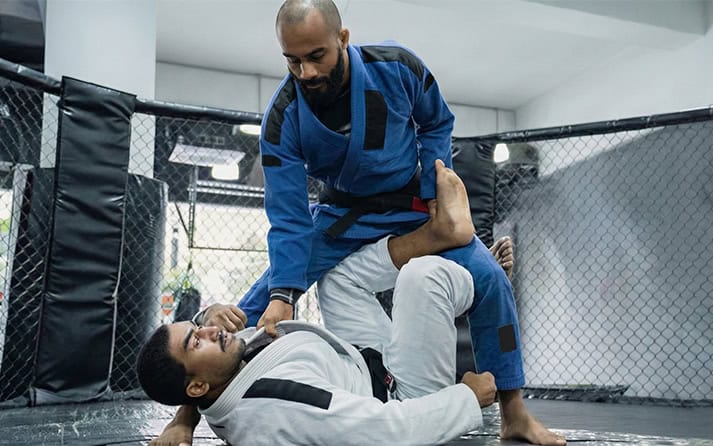
No position is perfect, and the X-Guard is no exception.
Advantages
- Excellent for sweeps and reversals.
- Provides positional safety and tight control.
- Leads naturally into leg submissions and back takes.
Disadvantages
- Requires timing and solid hip mobility.
- Vulnerable to standing passes if your opponent disengages in MMA.
- Can be tricky to maintain under active striking pressure.
Still, for fighters who build it into their ground game, the pros easily outweigh the cons. The X-Guard MMA setup is one of the most versatile weapons you can learn.
Common Mistakes & How to Avoid Them
- Not controlling posture. If you forget your grips, your opponent stands and walks away.
- Incorrect leg placement. A sloppy “X” means no leverage, no sweep.
- Lack of core engagement. Without that lift from your core, your opponent’s base stays solid.
- Neglecting transitions. The X-Guard isn’t a place to rest. You should always be flowing into sweeps, submissions, or stand-ups.
Your X-Guard entries and transitions are going to feel smooth and unstoppable.
Drills & Training Tips to Master the X-Guard
Want to make the X-Guard second nature? Drill it until it feels boring, that’s when it’s working.
- Positional Drills: Enter X-Guard from butterfly or half guard.
- Sweep Repetitions: Hit 20–30 X-Guard sweeps per session.
- Flow Rolling: Chain transitions – X → Single-leg X → Back take.
- Resistance Rounds: Let your partner try to escape or stand – learn how to adapt mid-roll.
And here’s a pro tip: study the Marcelo Garcia X-Guard videos. Watch how seamlessly he shifts from off-balance to sweep to control. Or check out modern MMA adaptations from athletes like Gordon Ryan. They’ve taken the same principles and made them fight-ready.
Consistency beats creativity when you’re learning this. Drill it daily. Let it become part of your instinct.
FAQ’s
The X-Guard MMA position is one of those timeless grappling tools that connects old-school BJJ with modern mixed martial arts. It’s technical but not out of reach – a blend of control, balance, and leverage that can flip a fight in seconds. From sweeps to leg locks, it offers endless pathways to victory.
Whether you’re just starting out or chasing black belt mastery, learning the X-Guard sweeps will change how you see the ground game – just like it did for Marcelo Garcia and every fighter who followed his lead.