



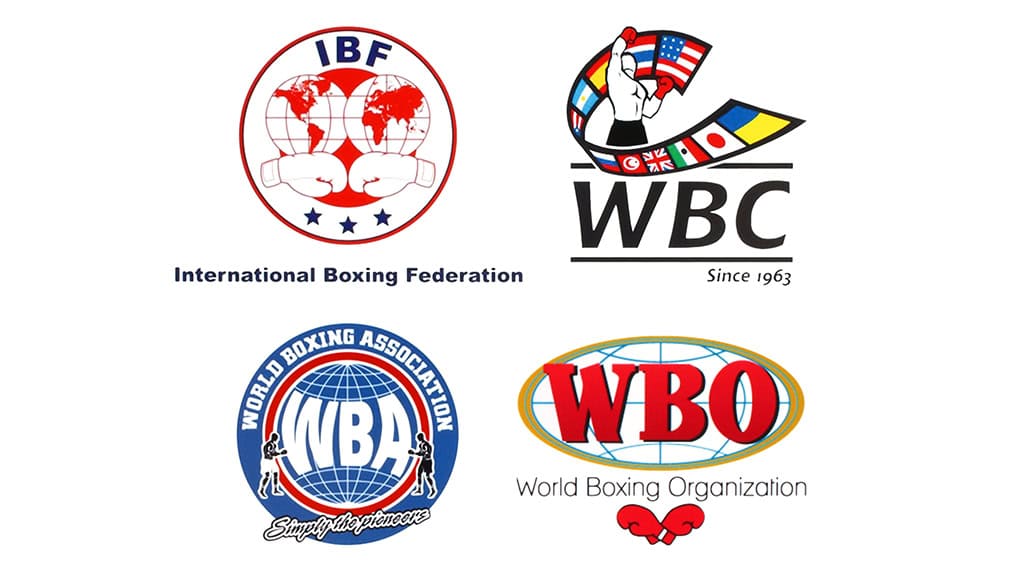
Boxing fans toss around acronyms like they’re trading cards. WBA. WBC. IBF. WBO. They sound neat, decisive, like badges of honor pinned to a fighter’s chest. But what do those belts actually mean? Why does one fighter parade a green sash and another hold up a gold-plated strap and suddenly the conversation changes?
This piece will walk through the big players and the straps they hand out. We’ll trace where the belts came from, why they matter, and how a fighter becomes the very top – the rare breed who holds every title at once. If you know the basics already, great. If you don’t, consider this boxing belts explained for beginners. Either way, expect some history, a few grudges, and the odd bit of boxing trivia you can drop at the next gym meet.
The WBA Boxing Belt: A Brief History and Its Importance
The WBA boxing belt comes with history, old-school history. The World Boxing Association was founded in 1962, though its lineage traces back even earlier under different names. That makes the WBA one of those organizations that shows up in older fights and in the record books like a familiar ghost. It has evolved through rule changes, politics, and the general chaos of a sport that often rewards showmanship as much as honesty.
What the WBA did was institutionalize a way to crown champions across multiple weight classes worldwide. Over time, though, it got complicated. You’ve probably heard about “regular” champions and “super” champions under the WBA banner.
That split happened because they wanted to keep recognizing big-name titleholders who also fought in different weight classes or unified titles. The result was a hierarchy inside the organization itself. It was helpful at times but made things messy at others.
Fighters like Muhammad Ali, Manny Pacquiao, and Canelo Álvarez have all carried WBA recognition at some point. That’s not accidental. The WBA’s title still opens doors. Promoters use it as leverage. Broadcasts use it as a headline. For a fighter, a WBA strap is not just metal. It’s visibility, negotiation power, and historical resonance. In the messy world of boxing politics, that matters.
Related Article: The Greatest Boxers of All Time: Ranking the Top 10 Fighters in History
The WBC Boxing Belt: The Most Prestigious Title
Ask around in any gym and someone’ll say the WBC boxing belt is the crown every kid dreamt about as they skipped rope. Founded in 1963, the World Boxing Council quickly built an image of being the most glamorous with a good share of strictness. The WBC’s green strap is iconic. It’s instantly recognizable. That color, the belt’s design, the way it’s handed out on big nights; it all adds to the aura.
Why do many people call it the most prestigious boxing belt? A few reasons:
- The WBC was early in pushing for international standards like uniform gloves, medical protocols, and fighter safety rules in various eras.
- They also had a knack for negotiating high-profile title fights.
Critics will say “prestige” is a feel more than a rulebook thing. But prestige counts in boxing. It makes a difference at the box office. It makes a difference when networks decide which fights to air.
Names like Floyd Mayweather, Mike Tyson, and Deontay Wilder are often linked to the WBC. Those fighters weren’t just great boxers; they were headline makers. The WBC title has a history of being displayed in the ring like a status symbol. Whether you’re a purist or a casual fan, when you see that green belt, it registers.
The IBF Boxing Belt: What Makes It Unique?
The IBF boxing belt came late to the party but it made noise fast.
Born in 1983, the International Boxing Federation didn’t have the history of the WBA or WBC, but it had something else – rebellion. It was built by people fed up with the politics, looking to clean up the system and give rankings some real order.
And that’s what made the IBF different.
It actually stuck to the rules. Mandatories. Rankings. Structure. Stuff the other bodies, sometimes treated loosely. Fighters and promoters might roll their eyes at those strict mandates, especially when it messes with a big-money unification but it keeps everyone active. No hiding behind excuses.
If you wear that red IBF strap, you fight. Simple as that.
Names like Evander Holyfield, Vasyl Lomachenko, and Anthony Joshua have all had it wrapped around their waist. And whenever a unification fight happens, that red belt usually means business.
Because when the IBF’s in the mix, it’s not just another piece of gold, it’s a test of who’s really earned it.
The WBO Boxing Belt: A Rising Champion
The WBO boxing belt started in 1988. If it was a youth in the world of sanctioning bodies, it’s a young professional now. The World Boxing Organization didn’t have the same instant gravitas as the WBC or WBA, but over the decades the WBO did something simple and effective: it kept producing credible champions and enforced rankings that could not easily be dismissed.
That steady accumulation of results like good fights, respected champions, consistent sanctioning – changed perception. By the 2000s, the WBO was very much in the “major” conversation. Fighters such as Manny Pacquiao, Terence Crawford, and Tyson Fury have held WBO recognition, and that helped push the organization into mainstream respectability.
What the WBO offered was another path to the top. In an ecosystem where fighters juggle belts and promoters juggle money, the WBO became a pragmatic route to recognition, especially for fighters climbing through the ranks and seeking legitimacy.
Understanding Boxing Belts for Beginners: What’s the Difference?
Let’s clear the fog around boxing belts. At a glance, belts are all the same: shiny, heavy, and drama-inducing. But they’re different in structure and in the rules that define them.
Belt Hierarchy
Start with the belt hierarchy. Some organizations have “regular” champs and “super” champs. The WBA, for instance, often uses the terms “regular” and “super” to distinguish fighters who hold multiple titles or who have defended longer. “Interim” champions exist too. These are placeholders, belts awarded when a primary champion can’t defend due to injury, scheduling, or other issues. It’s a practical fix, but it also creates confusion.
Unified and Undisputed Champions
Then there’s the Unified and Undisputed Champions concept. An undisputed boxing champion is the name thrown around in hushed reverence. To be undisputed, a fighter must hold all four major belts at once: WBA, WBC, IBF, and WBO. That’s the clean, unequivocal assertion that a fighter is the best in the division – no qualifiers, no split claims.
Lineal Champion Meaning
But there’s also the lineal champion meaning, which is different. Lineal champions are decided by a lineage: “the man who beat the man.” It’s less about organizational politics and more about continuity. Lineal status can fall out of sync with the belts. A fighter might be a lineal champion without holding every major belt. It’s purer in concept but messier in practice when belts and lineage disagree.
So the difference between boxing belts boils down to authority and process. Sanctioning bodies create rankings, mandate fights, and collect fees. Lineage and public opinion create narrative. Both matter, but they play different roles. One runs the paperwork. The other runs the myth.
Related Article: What Does Pound-for-Pound Mean in Boxing? History, Criteria & Legends Explained
FAQ’s
Boxing isn’t just a sport. It’s a show. A gamble. A business with gloves on. You don’t need to memorize every detail. Just understand what’s at stake. Because behind every belt, there’s a grind. Years of blood, noise, and split decisions. And somewhere right now, in some quiet gym, a kid’s throwing jabs at a dream. He’s not thinking about politics or sanctioning bodies. He just wants that belt.
And that’s the beauty of it – the fight never stops.